Shopping Cart
There are no more items in your cart
.jpg)
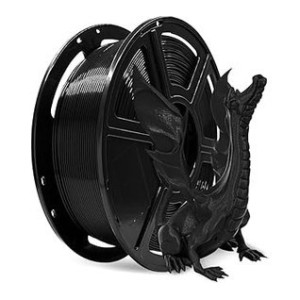
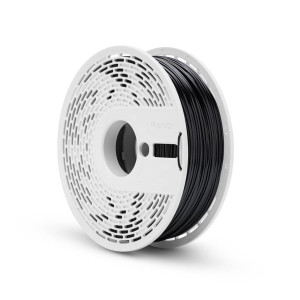
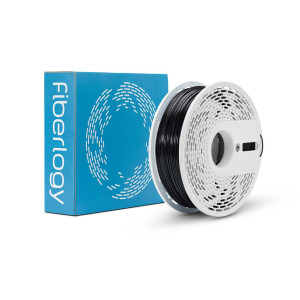


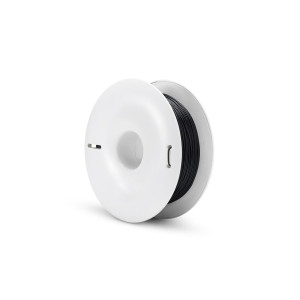
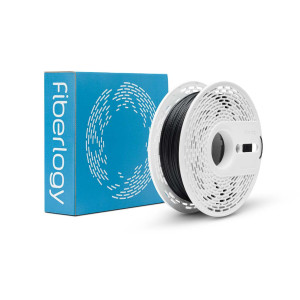

Carbon fiber reinforcement adds stiffness.

Less warping, more stable dimensions.

For PA12 + CF15, check heat-deflection conditions in the current manufacturer documentation, including load and print conditions.
The Simplify3D guide notes that carbon fiber filaments are abrasive, require a hardened steel nozzle and clog more easily. For PA12 + CF15, Fiberlogy recommends 255–270 °C, a 110 °C bed and drying at 80 °C for 4 hours.
Carbon-filled PA, PETG, PCTG and TPU are different materials. Check the base polymer and exact series after reading the reinforcement label. PA grades need moisture preparation, PETG grades need surface compatibility, and TPU grades need feeding and flexibility review. One CF series' temperature or drying programme is not a recipe for every reinforced filament. A fixture may need a loaded face to retain position, while a protective part needs some deflection. Stiffness and impact behaviour are different properties; a less flexible part is not necessarily more durable in every direction. Read technical results with their test method and specimen orientation. Compare PA12 + CF15, PETG-CF10 and PCTG + CF using the same part and load description.
Short carbon fibres can wear a nozzle; follow the manufacturer's wear-resistant nozzle guidance. Check recommended diameter and hotend compatibility alongside nozzle material. Read the abrasive-material guidance for an automatic spool system separately where one is used.
After changing the nozzle, follow the printer's calibration procedure and trial the appropriate material profile. For irregular line width or flow loss, inspect nozzle and feeding condition first rather than attributing every symptom to temperature. Fiberlogy's CF/GF guidance specifically addresses brass-nozzle wear. Keep material, nozzle and profile records together without inventing a fixed nozzle lifespan or spool-count replacement interval.
Brackets, fixtures and drone components experience different loads. Mark critical sections and holes on the drawing and plan orientation and support contact around them. Fibre reinforcement does not remove differences associated with layer direction. Compare specimens of the same series in different orientations to assess application behaviour.
Inspect dimensions after printing and any required post-processing. Record moisture conditions for PA-based materials. If a data-sheet revision and product-page value use different conditions or conflict, do not merge them into one definitive number. Use the current grade documentation and assess application suitability with a specimen. Record deflection, joint behaviour and finish separately instead of accepting the part from light weight or matte appearance alone.
Why 3D Grande?

Smart Materials 3D and FlashForge distributor for Türkiye; Fiberlogy and Azurefilm supplied by 3D Grande.

Shipped within 1 business day, delivered in 2–4 business days across Türkiye.

Returns accepted within 14 days; we cover return shipping.
Let's Pick a Carbon Fiber Filled Filament
Tell us about your part and your printer's nozzle, and we will recommend a carbon fiber filled filament.
About
Carbon fiber filled (CF) filaments add short carbon fibers to a base polymer such as PLA, PETG, PCTG, nylon or TPU. The fibers increase stiffness and dimensional stability while keeping weight low, which makes them popular for fixtures, jigs, drone and automotive parts. Because the fibers are abrasive, a hardened steel nozzle is required, and the filament can be more brittle than its unfilled version. 3D Grande stocks carbon fiber filaments from Fiberlogy and Smart Materials 3D.
Begin by defining allowable deflection and loading points for a reinforced component. A locating fixture body and a snap tab that must flex do not require identical selection. The reinforcement label should not obscure base-polymer service and printing conditions. Keep technical data under the exact product name when changing materials.
Share nozzle material, printer and a section view in the enquiry, including heat or chemical exposure. Comparing specimens without changing series, geometry and orientation simultaneously helps trace the result. A sample tied to its production record gives later prints a concrete reference.
Related pages: Fiberlogy PA12 + CF15 · Fiberlogy PCTG + CF · FlashForge PETG-CF10 · PA (polyamide) filament